
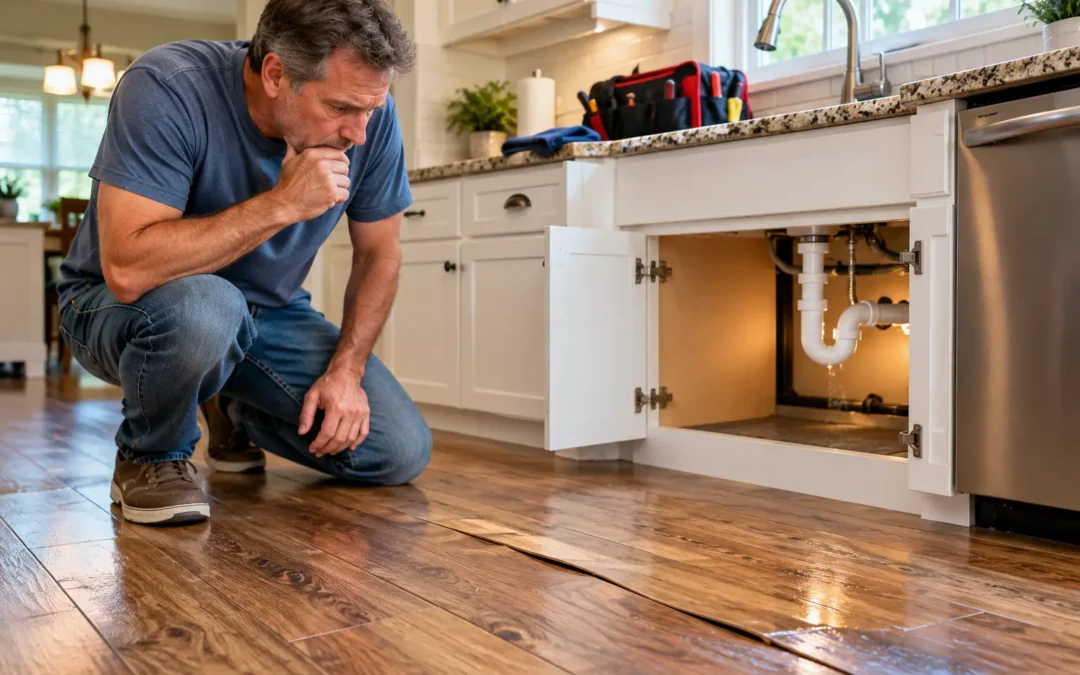
The plumber found the leak. The water was shut off. The broken pipe was repaired.
Problem solved…right?
Maybe.
Fixing the plumbing problem stops the source of the water. But it doesn’t necessarily tell you where the water traveled before the leak was discovered.
Water may have reached drywall, insulation, flooring, cabinets, baseboards, or other areas before anyone knew there was a problem. Sometimes those effects are obvious. Other times, the first clue may be a stain, swelling material, a strange odor, or something that simply doesn’t look or feel the way it did before.
None of that automatically means there’s hidden damage, and it doesn’t tell you whether a particular condition is covered by insurance. But it raises a question many homeowners never think to ask once the plumber packs up his tools:
“Did we fix the whole problem—or did we only fix the thing that caused it?”
That’s where the story of a plumbing leak can become much more interesting.
Because after the pipe is repaired, there’s another question worth asking:
Where did all that water go?
The Plumber’s Job and the Water’s Story Aren’t Always the Same Thing
When a plumber arrives at a leaking home, the immediate priority is usually pretty straightforward: find the source and stop the water. Maybe it’s a failed supply line under a sink, a connection behind a toilet, a refrigerator line, a pipe inside a wall, or another plumbing component that suddenly let go.
Once the source is found and repaired, there’s an understandable feeling of relief. The water has stopped. The plumbing works again. The emergency appears to be over.
But here’s something homeowners don’t always think about: the plumber may be able to tell you where the water came from without being able to tell you everywhere the water went.
Water doesn’t necessarily stay beside the broken pipe. Depending on the location and how long the leak continued, it can move beneath flooring, behind baseboards, through openings around cabinets, into drywall, or into adjoining areas. Some affected materials may be obvious immediately. Others may not be.
That’s why one of the most useful things you can do after the source is repaired is mentally retrace the event. Where was the water first noticed? What was wet? Which direction could it have traveled? What rooms or materials were nearby? And what looks or feels different now?
You don’t need to tear into walls or start pulling up flooring to answer those questions. And you shouldn’t disturb materials or enter areas that may be unsafe. The idea is much simpler: don’t let “the leak is fixed” automatically become “everything the leak affected has been identified.”
Those are two different questions.
And sometimes, that distinction is where the rest of the story begins. 🧭
Before You Throw Anything Away, Take a Few Pictures
After a plumbing leak, cleanup can happen fast. Wet towels get tossed in a pile. A plumber removes a failed supply line or broken fitting. Damaged baseboard comes off. A restoration company may begin removing wet materials. Everyone is understandably focused on getting the house dry and usable again.
But in that rush, homeowners can accidentally lose something valuable: a clear record of what the situation looked like before everything changed.
If it’s reasonably safe to do so, take photographs or video before damaged materials are removed or discarded. Photograph the area where the leak was discovered, the surrounding flooring and walls, nearby cabinets or furniture, and anything visibly affected by the water. Step back and take wider photographs too. A close-up may show damage clearly, but a wider picture shows where that damage was located in the home.
If a plumber identifies a failed component, ask what was found and keep the invoice or service record. If the removed part can reasonably and safely be retained, ask whether it should be kept. And save receipts for emergency work and other expenses related to the event.
Florida’s Department of Financial Services also recommends documenting necessary emergency repairs, keeping receipts, and taking photographs or video before and after repairs.
None of this means you should delay necessary steps to stop the leak, dry the property, or prevent additional damage just to take photographs. Protecting the home comes first. The goal is simply to preserve what you reasonably can while the evidence is still there.
Then ask yourself one question:
“If everything gets cleaned up tomorrow, could I still show someone what happened today?”
If the answer is yes, you’ve already done something useful before trying to figure out anything more complicated. 🧭
The Wet Spot You Can See May Not Be the Edge of the Water
When water ends up on a kitchen floor or beneath a bathroom sink, it’s natural to focus on the area that looks wet. You wipe it up, put down towels, maybe run some fans, and watch the surface begin to dry.
But the visible edge of the water isn’t necessarily the same thing as the edge of the affected area.
Think about where the water had an opportunity to go. Was there a gap beneath the cabinet? Could it have reached the baseboard? Was the flooring continuous into another room? Did water collect against a wall? If the leak happened upstairs, was there a room or ceiling directly below it?
This doesn’t mean you should assume water traveled into every nearby material. It means what you can see from the surface may not answer the question by itself.
And there can be another clue: time.
Maybe the floor looked fine on the first day but began to change later. A baseboard swelled. A cabinet edge started looking different. A stain appeared on the other side of a wall. Flooring began to lift or separate. Or a room developed an odor that wasn’t there before.
Instead of immediately deciding what those changes mean, document them and ask:
“Does this line up with where the water could have traveled?”
That’s a much better starting point than guessing.
Because once you know where the leak started, the next question isn’t simply “Where was the water?”
It’s:
“Where could the water have gone before we stopped it?” 🧭
A Dry Surface Doesn’t Always Answer the Question
A few days after a plumbing leak, the house may begin looking normal again. The floor feels dry. The towels are gone. The plumber has left. Maybe you’ve even stopped thinking about the leak.
But there’s an important distinction between something looking dry and knowing what was affected.
Different materials can respond to water differently. Drywall, wood, cabinets, insulation, flooring and the materials underneath flooring don’t necessarily dry at the same rate. That’s one reason professionals may use moisture meters or other tools when evaluating areas that were exposed to water.
That doesn’t mean every plumbing leak requires an extensive investigation. A small leak discovered immediately may truly have a small affected area. The point is not to assume the opposite.
The better question is:
“How do I know the affected area ended where I can see it?”
Maybe there is a perfectly good answer. Perhaps the area was checked, documented and dried, and everything makes sense.
But if nobody ever looked beyond the visible wet spot, “it looks dry now” and “we know where the water went” aren’t quite the same answer.
And that’s a distinction worth understanding. 🧭
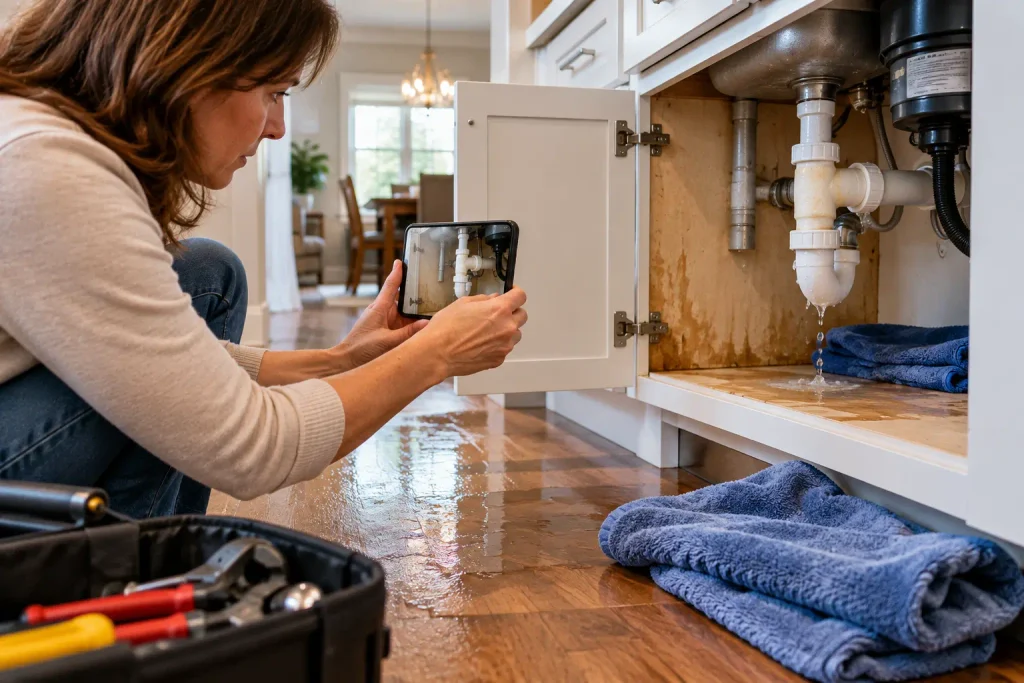
Stopping the leak answers where the water came from. It doesn’t always answer where the water went.
What Did the Plumber Actually Document?
After a plumbing emergency, it’s easy to think of the plumber’s invoice as simply a bill. But take another look at it. That piece of paper may contain some of the earliest written information about what happened in your home.
Does it identify the failed pipe, fitting, supply line, valve, or other component? Does it describe where the leak was located? Does it say anything about water being present when the plumber arrived? Were photographs taken? Did the plumber make any notes about nearby materials or areas that appeared wet?
Now compare that information with your own photographs and what you remember seeing.
You aren’t looking for the plumber to determine insurance coverage or document every part of a property-damage claim. That’s not necessarily what the plumber was hired to do. You’re trying to preserve the factual pieces of the story while they’re still easy to find.
Because six weeks from now, “There was water everywhere under the sink” may be difficult to reconstruct from memory.
A dated photograph, a plumber’s invoice, and a few notes made on the day it happened can tell a much clearer story.
And here’s the question most homeowners never think to ask:
“If I had to reconstruct this leak six months from now, what would I have besides my memory?”
What If Something Changes After the Cleanup?
Once the immediate mess is gone, it’s tempting to consider the event finished. But your home may give you additional information over the next several days.
Maybe a cabinet panel begins to swell. Flooring develops a raised edge or separation that wasn’t noticeable before. A baseboard changes shape. A faint discoloration appears on the other side of a wall. Or you notice a damp or musty odor in an area that seemed fine when the leak first happened.
Those changes don’t automatically tell you what caused them. They also don’t mean you should assume there’s serious hidden damage. But if something new appears after a known water event, it’s worth documenting when you first noticed it and how it changes.
Take a photograph. Take another from farther away so the location is clear. Write down the date. If you have earlier photographs of the same area, compare them.
Then go back to the information you already have: the plumber’s invoice, photographs from the day of the leak, any drying or repair records, and—if an insurance claim was opened—the inspection and claim documents.
Now ask:
“Is what I’m seeing today part of the same story—and if it is, has anyone documented it?”
You don’t have to know the answer.
But that’s a much better question than assuming that because the pipe was repaired, the story ended when the plumber left. 🧭
Plumbing Leak — Claim Compass Checkpoint 🧭
By this point, you may be realizing that a plumbing leak actually involves two different stories: what failed, and what the escaping water affected before the problem was stopped.
So think back to your own leak.
Do you know exactly where the water started? Do you have photographs showing what the area looked like before cleanup began? Did anyone check beyond the visibly wet area, or was the focus mainly on repairing the plumbing and cleaning up what could be seen?
What about the days afterward? Did any flooring, baseboards, cabinets, walls, or ceilings begin looking different? If something changed later, did you photograph it and record when you first noticed it?
And here’s the question that ties everything together:
If the plumber fixed the source of the leak, who determined where the water actually went?
There may be a perfectly good answer. Maybe the affected areas were identified, documented, dried, and addressed.
But if your answer is “I’m not really sure,” that’s useful information too.
It doesn’t prove there’s hidden damage.
It simply tells you that one part of the story may still deserve a question.
When the Leak Is Fixed but the Questions Aren’t
A plumbing leak can feel simple once the water stops. Something broke, the plumber repaired it, the floor dried, and life started getting back to normal.
Sometimes, that really is the whole story.
But sometimes a homeowner is left with questions that don’t show up until later. Why is that cabinet beginning to swell? Was the flooring beneath the visible water ever checked? What caused that new discoloration? Did anyone document the areas beyond the original leak? And if an insurance claim was opened, does the claim reflect what was eventually discovered—not just what was visible on the first day?
You don’t need to assume something was missed. And you don’t need to become a plumber, moisture expert, contractor, or insurance professional to ask sensible questions about your own home.
Start with what you know. Where did the water come from? Where did you see it? What changed afterward? What was documented? And what are you still unsure about?
Those questions may lead to a very simple answer.
Or one of them may lead you to something worth taking another look at.
Because fixing the pipe may have ended the leak.
Understanding what the water affected is how you finish the story. 🧭
Still Have Questions About Where the Water Went?
If you’ve had a plumbing leak and you’re not sure whether everything affected by the water was identified and documented, you don’t have to figure it all out yourself.
Tell us what happened.
Maybe the plumber fixed the source but you’re noticing changes afterward. Maybe an insurance inspection has already taken place. Or maybe you’re simply looking at the situation and thinking, “I’m not sure anyone ever checked beyond the obvious wet area.”
We can start there.
A conversation doesn’t mean there’s something wrong with your claim, and it doesn’t mean you need to make a decision today. It simply gives you a chance to explain what happened, what you’re seeing now, and what questions you still have.
Sometimes the pieces fit together perfectly.
Sometimes one piece deserves another look.
There’s no charge to start the conversation.