
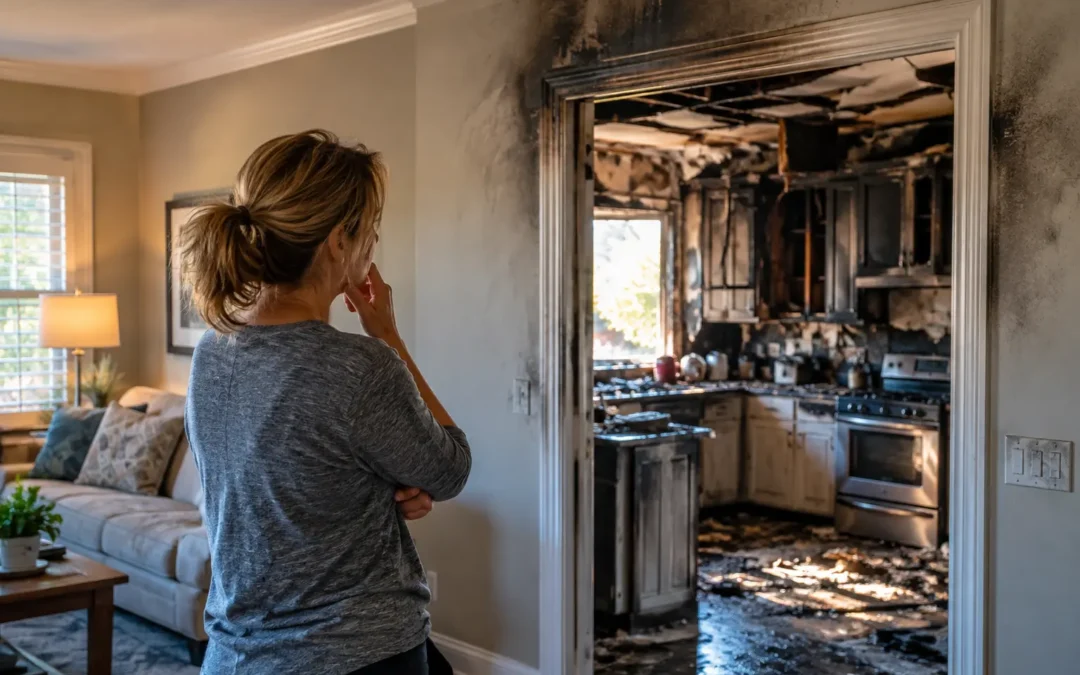
The flames may have been contained to one room.
That’s good news.
But after the fire department leaves and the immediate danger has passed, homeowners can understandably focus on the place where the fire actually burned.
The blackened wall. The damaged cabinets. The burned furniture. The room everyone can see.
But fire doesn’t necessarily affect a home only where flames were visible. Smoke and soot can move into adjoining rooms and other areas. Heat can affect nearby materials. And the water used to extinguish a fire can create an entirely different path through the property.
So before looking at the burned room and deciding “that’s the damage,” there’s another question worth asking:
“Did anyone determine where the effects of the fire stopped?”
That doesn’t mean every room in the house was damaged.
It means the edge of the burned area and the edge of everything affected by the event may not necessarily be the same thing.
And that’s where a fire-damage inspection can become much more interesting than simply looking at what burned.
Smoke Doesn’t Need Flames to Travel
When people picture fire damage, they naturally picture what burned. But smoke can move well beyond the room where the flames were contained.
It can travel through open doorways, hallways, stairwells, and other pathways in a home. Depending on the circumstances, smoke and soot may reach rooms that never came close to the flames.
Sometimes the evidence is obvious. You may see dark residue around a doorway, discoloration on a wall or ceiling, or soot on nearby surfaces. Other times, the first thing a homeowner notices is simply that a room away from the fire doesn’t smell or feel the way it did before.
That doesn’t mean every smoky odor or dusty surface represents significant fire damage. And it doesn’t mean a homeowner should start wiping surfaces or disturbing residue just to investigate it.
Instead, once the property has been declared safe to enter, take a moment to think about the house differently.
Don’t ask only:
“What burned?”
Ask:
“What rooms were exposed to what the fire produced?”
Then think about something even more revealing:
If the fire was contained to one room, how was it determined that the effects of the fire were contained there too?
That’s a different question.
And it may be the first question that helps you understand whether everyone has been looking at the fire itself—or the whole house. 🧭
The Room Next Door May Tell You More Than You Think
After a fire, attention naturally stays on the room where the flames were visible. That’s where the photographs get taken, where the obvious cleanup begins, and where everyone tends to gather when discussing what happened. But once the property is safe to enter, it can be useful to look at the rooms surrounding the fire—not because you should assume they’re damaged, but because they may help show how far smoke, soot, heat, or firefighting water traveled.
Walk through the sequence of the event in your mind. Which doors were open? Where did you first notice smoke? Did smoke move down a hallway or upstairs? Were windows opened during or after the fire? Did firefighters have to move through other parts of the house? Were ceilings, walls, floors, furniture, or belongings wet in areas where nothing actually burned? Those details can help turn a chaotic memory into a much clearer picture of what happened.
Photographs can be especially useful here. Once it is safe, take wide pictures showing entire rooms before focusing on individual surfaces or belongings. A close-up may show soot or discoloration, but a wider photograph establishes where that condition was located in relation to the fire. If you have ordinary photographs of the home from before the event, those may also provide a useful comparison.
The point isn’t to walk through the house trying to prove that everything was damaged. It’s to understand where the effects of the event actually ended. If the answer is obvious, great. But if nobody can really tell you why the assessment stopped at one doorway while smoke, soot, odor, or water continued beyond it, that’s a reasonable question to keep asking.
The Flames May Be Out — But Where Did the Water Go?
Water used to extinguish a fire can create a second part of the damage story that is easy to overlook. When firefighters are working to stop a dangerous situation, their priority is protecting people and putting out the fire—not keeping water neatly inside the room where the flames started. Depending on the event, water can move across floors, beneath materials, through wall openings, or into rooms and levels below.
That means a homeowner may walk into a room where nothing burned and still find wet flooring, stained drywall, swollen baseboards, affected cabinets, or water that traveled from somewhere above. In a multi-story home, it can be especially useful to think vertically: what rooms are directly beneath the area where the firefighting took place?
Again, the goal isn’t to assume every wet material has permanent damage. Some materials may be dried successfully, and the circumstances of every fire are different. The useful part is making sure the water portion of the event doesn’t disappear from the story simply because the flames are more dramatic.
Photographs taken once authorities say it is safe to enter can help preserve that story. Wide photographs can show where water was located in relation to the fire area, while closer photographs can document specific conditions. If water changes a ceiling, floor, cabinet, or wall over the following days, recording when you first noticed the change can also help establish a timeline.
And this leads to a question that can easily get lost after a frightening event: when the fire damage was evaluated, was the path of the firefighting water evaluated too?
Because the thing that saved the house can sometimes become another part of understanding what happened to it. 🧭
The House Isn’t the Only Thing That Tells the Story
After a fire, it’s understandable to focus first on the structure—the burned wall, damaged ceiling, flooring, cabinets, or the room where the fire began. But a home is also filled with furniture, clothing, electronics, artwork, photographs, bedding, books, and hundreds of ordinary belongings that may have been exposed to smoke, soot, heat, or water even though they never touched a flame.
This is one area where moving too quickly can make the situation harder to reconstruct later. Once it is safe to do so, photographs or video of rooms and their contents can help preserve what was there and where it was located before items are moved, cleaned, discarded, or taken elsewhere. Wider room photographs can be particularly helpful because they provide context that a close-up of an individual item may not.
Florida’s Department of Financial Services also recommends photographing damaged property, keeping records and receipts for necessary repairs, and creating an inventory of damaged personal belongings.
You also don’t have to decide immediately what can be cleaned, what can be restored, or what ultimately needs to be replaced. Those decisions can depend on the item, the type and extent of exposure, and the professionals involved. The important thing early on is to avoid turning a house full of belongings into a memory exercise before you’ve created a reasonable record of what was there.
Then consider the rooms where nothing burned. Were the belongings in those rooms evaluated too, or did the assessment of contents stop roughly where the visible fire damage stopped? There may be a perfectly reasonable answer, but it’s a useful question because smoke doesn’t organize itself according to room boundaries.
After a fire, the inventory of what happened isn’t necessarily just a list of what burned.
Sometimes it’s also a record of what was exposed. 🧭
An Inspection Can Only Document What Is Known at the Time
The first inspection after a fire can feel like a major milestone. Someone walks through the property, takes photographs, makes notes, looks at the damaged areas, and begins putting together a picture of what happened. For a homeowner who has just been through a frightening event, it’s easy to assume that once that inspection is finished, the full extent of the damage has been captured.
But a fire-damaged home can continue revealing information after that first visit. Materials may be moved during cleanup. Wet areas may become more apparent. Smoke or odor concerns may be noticed in rooms that received little attention initially. Contractors may uncover conditions that weren’t visible when walls, ceilings, cabinets, or other materials were still in place.
None of that automatically means the first inspection was inadequate. An inspector can only evaluate the conditions that are visible and accessible at the time. The more useful question is what happens when new information becomes available afterward.
This is where your photographs, notes, repair records, inventories, and observations begin working together. If something new is discovered, document what was found, where it was located, and when you learned about it. Then compare that information with whatever inspection records, estimates, or claim documents you already have.
You’re not looking for someone to blame. You’re asking something much more practical:
“Does the picture of my claim today still match what we’ve learned about my home since the first inspection?”
If it does, that’s reassuring.
If you’re not sure, that’s a question worth resolving before the story of the fire is considered finished. 🧭
Fire Damage — Claim Compass Checkpoint 🧭
By now, you can probably see why the room where the fire started is only one part of the story. The flames may have been contained, but smoke, soot, heat, firefighting water, and the movement of people and materials during the emergency can create a much larger picture to understand.
Think about your own home for a moment. Do you know which rooms were actually evaluated after the fire? Were areas beyond the visible burn damage looked at for smoke or soot? Was anyone documenting where firefighting water traveled? Were belongings in rooms away from the fire considered, or was most of the attention naturally concentrated on the area that looked the worst?
Then think about what happened after the first inspection. Were additional conditions discovered during cleanup? Did an odor remain somewhere you didn’t expect? Did water-related changes appear later? Did a contractor or restoration company find something that wasn’t visible on the first day? If so, do you know whether that newer information became part of the claim?
You don’t need to assume something was overlooked. Maybe the entire property was evaluated carefully and everything you’ve discovered since then is already accounted for.
But there’s one question that brings the whole article together:
“If the fire was contained to one room, how do I know the damage was contained there too?”
If you have a clear answer, great.
If your answer is “I don’t really know,” that’s not proof of a problem.
It’s a reason to ask one more question. 🧭
Before You Decide the Fire Damage Is Fully Understood
After a fire, getting back to normal can become the only thing you want. You want the cleanup finished, the repairs underway, and the disruption behind you. Once an inspection has happened and paperwork starts arriving, it can be tempting to assume that the difficult part—figuring out what was actually affected—has already been completed.
Maybe it has.
But before you close that chapter, look at the event one more time from beginning to end. Start with the room where the fire occurred, then think outward. Where did the smoke travel? Where was soot found? Where did firefighters use water? What happened to the rooms below or beside the fire? What belongings were exposed? And what was discovered only after cleanup or repairs began?
Then compare that story with what was actually documented.
You aren’t trying to find damage that isn’t there, and you don’t need to assume anyone did anything wrong. You’re simply asking whether the complete story of what happened to your home is the same story reflected in the inspection and claim documents.
Sometimes that comparison gives a homeowner peace of mind.
Sometimes it produces one question they hadn’t thought to ask.
And sometimes that one question changes what they realize they need to look at next.
Because after a fire, the most important question may not be “What burned?”
It may be:
“Did we account for everything the fire affected?” 🧭
Not Sure the Whole Fire Damage Story Was Captured?
After everything that happens during a fire, it’s completely reasonable to have questions afterward. Maybe the fire itself was contained to one room, but you’re noticing smoke or odor elsewhere. Maybe firefighting water reached another part of the house. Maybe belongings in rooms away from the fire were affected. Or perhaps an inspection has already happened and you’re simply not sure what was actually included.
You don’t have to diagnose the damage or decide for yourself whether something was missed before reaching out. Tell us what happened and what you’re seeing now. We can start with the sequence of events—the fire, the areas affected, the inspection, and the questions that still don’t seem to have a clear answer.
Sometimes everything fits together once the documents and damage are looked at as one story. Sometimes there’s an area or condition that deserves another look. Either way, asking the question doesn’t commit you to anything.
If you’ve reached the point where you’re thinking, “I’d just like someone who understands property claims to look at the whole situation,” that’s a reasonable place to start.
There’s no charge to start the conversation.