
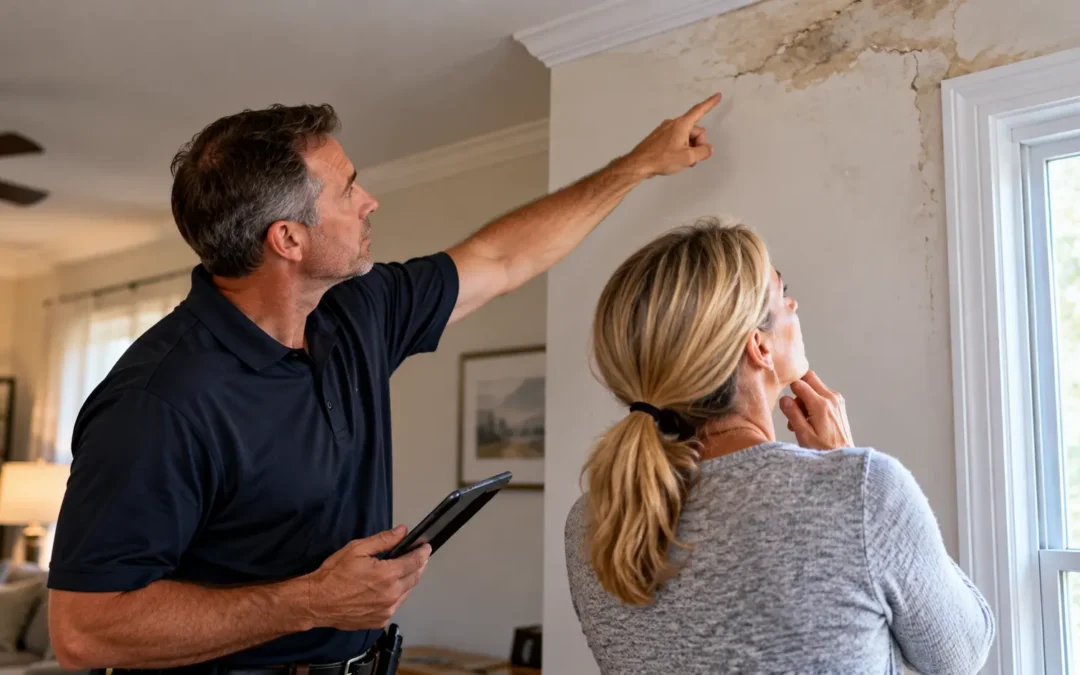
An insurance adjuster inspected your home. Photographs were taken. Measurements may have been made. You answered questions and showed the areas where you could see damage.
So when the inspection was over, it probably felt reasonable to assume one thing:
They found everything.
But what happens when damage shows up later — or when something you thought was part of the claim doesn’t appear in the estimate or paperwork?
That doesn’t automatically mean someone did something wrong. Property damage can be complicated. Some damage is obvious. Some is concealed. And some may not become apparent until days or even weeks after the original inspection.
Understanding what an insurance inspection can — and cannot — reveal may help you recognize when there are still unanswered questions about your home.
Here are 7 reasons damage may be missed during an insurance claim inspection — and what homeowners should know about each one.
1. The Inspection Is a Snapshot in Time
An insurance inspection documents what can be observed at a particular point in time. But property damage doesn’t always reveal itself all at once.
Moisture may continue moving through building materials. Flooring can begin to swell or buckle later. Staining may become more noticeable as materials dry. Odors can develop. And damage that wasn’t obvious during the first inspection may become easier to recognize afterward.
This doesn’t necessarily mean the original inspection was performed incorrectly. It simply means your home can tell a different story several days later than it did on the day of the inspection.
That’s why continuing to photograph changes after an inspection can be important. If something new appears, document what you see and when you first noticed it.
The inspection may be over. The damage may still be revealing itself.
2. Water Doesn’t Always Stop Where the Stain Stops
When water damage is involved, the visible stain is often where the problem gets noticed — but it isn’t necessarily where the water stopped.
Water can move through wall cavities, beneath flooring, behind baseboards, through insulation, and along framing before becoming visible somewhere else. Two areas that look completely separate on the surface may even be connected by the same path of moisture.
During an inspection, attention naturally goes to the areas where damage can be seen. But adjoining rooms and materials along the possible path of the water may deserve attention too.
Moisture meters and thermal imaging can sometimes help identify areas that warrant a closer look, but neither tool by itself proves the cause or full extent of damage. They are pieces of information that can help guide further investigation.
If you notice new staining, swelling, buckling, discoloration, or other changes after the inspection, photograph them and note when you discovered them.
The stain may show you where the water became visible. It doesn’t necessarily show you everywhere the water went.
When water damage is involved, the visible stain is often where the problem gets noticed — but it isn’t necessarily where the water stopped.
Water can move through wall cavities, beneath flooring, behind baseboards, through insulation, and along framing before becoming visible somewhere else. Two areas that look completely separate on the surface may even be connected by the same path of moisture.
During an inspection, attention naturally goes to the areas where damage can be seen. But adjoining rooms and materials along the possible path of the water may deserve attention too.
Moisture meters and thermal imaging can sometimes help identify areas that warrant a closer look, but neither tool by itself proves the cause or full extent of damage. They are pieces of information that can help guide further investigation.
If you notice new staining, swelling, buckling, discoloration, or other changes after the inspection, photograph them and note when you discovered them.
The stain may show you where the water became visible. It doesn’t necessarily show you everywhere the water went.
3. Some Damage Is Hidden Behind Finished Surfaces
Homes are built in layers. Drywall covers framing and insulation. Flooring covers subfloors. Cabinets can conceal walls and plumbing. Tile, trim, and other finishes can hide materials that aren’t visible during a normal inspection.
That creates an important limitation: an area can look relatively normal from the room while something behind or beneath the finished surface deserves further attention.
This doesn’t mean walls or floors should automatically be opened just because water damage occurred. Unnecessary destructive investigation can create its own problems. But when the location of the water source, visible damage, moisture readings, or other evidence suggests that water may have reached a concealed area, it can raise reasonable questions about what cannot be seen.
Pay attention to changes after the inspection — flooring that begins lifting, baseboards that separate, paint that bubbles, drywall that changes color, or odors that weren’t noticeable before. Document those changes rather than assuming they’re unrelated.
Sometimes one of the most important questions isn’t:
“What can I see?”
It’s:
“What could be happening where I can’t see?”
4. The Reported Damage May Not Tell the Whole Story
When a claim is reported, the initial description may be fairly simple: water under the kitchen sink, a ceiling stain in the bedroom, or wet flooring near a leaking appliance.
That description is a starting point. It may not describe the full path the water took through the home.
By the time an inspection occurs, some water may have dried, been cleaned up, or moved into adjoining materials. The area where the problem was first noticed may therefore be only one part of the picture.
Think about the loss as a path rather than just a damaged spot. Where did the water originate? What materials were below or beside that location? Could gravity, openings, seams, or connected building materials have allowed it to travel farther?
This doesn’t mean every nearby room or building material was damaged. It means the physical path of the water can be worth considering when something doesn’t seem to add up.
A useful question after an inspection is:
“Did we only look at where the damage was reported — or did we follow where the water could have traveled?”
5. An Inspection and an Estimate Are Not the Same Thing
It’s easy to assume that if an area was photographed or discussed during the inspection, it will automatically appear in the insurance estimate. But an inspection and an estimate serve different purposes.
The inspection gathers information about the property and the reported loss. The estimate is a separate document that describes the repairs, quantities, materials, and costs being considered for the claim.
That’s why homeowners should actually read the estimate rather than simply looking at the total dollar amount.
Compare it with what you remember from the inspection. Are all of the affected rooms represented? Are the damaged materials you discussed included? Do the quantities seem consistent with the areas involved? Is something you specifically showed during the inspection absent from the document?
An omission doesn’t automatically mean the estimate is wrong. There may be an explanation, and coverage decisions are separate from simply observing damage. But if something you expected to see isn’t there, that’s a reasonable reason to ask a question.
Being inspected doesn’t necessarily mean being included.
And that’s why one of the most useful questions a homeowner can ask after receiving an estimate is:
“Does this document describe the same damage I remember walking through during the inspection?”
Water damage can be especially difficult because what you see at first may not show everywhere the water traveled. If you’re dealing with water damage, there are several things you should avoid doing before the damage is fully documented.
6. Different People May Be Looking at the Same Damage for Different Reasons
During a property claim, several people may eventually look at the same damage — an insurance adjuster, contractor, restoration company, plumber, roofer, engineer, or other specialist.
They may not all be looking for the same thing.
A plumber may be focused on identifying the source of a leak. A restoration professional may be concerned with drying affected materials. A contractor may be evaluating what will be required to repair or replace damaged components. An insurance adjuster may be documenting the loss and gathering information for the claim and coverage evaluation.
Because their roles are different, their observations and reports may emphasize different parts of the same event. That doesn’t automatically mean one person is right and another is wrong.
The useful question is whether those different pieces of information fit together.
If one report identifies a source, another documents moisture in an adjoining area, and another describes repairs, look at how those observations relate to one another rather than viewing each document in isolation.
When something appears inconsistent, ask for clarification and keep copies of the reports, photographs, estimates, and other information you receive.
Different professionals may be looking at the same house through different lenses.
The homeowner’s job isn’t to decide who the villain is. It’s to ask:
“Do all of these pieces tell a complete and consistent story about what happened to my home?”
7. Your Home May Keep Giving You New Information After the Inspection
An inspection may happen on one particular day, but your home doesn’t stop changing when the inspector leaves.
Over the following days or weeks, you may notice things that weren’t apparent before. Flooring may begin to buckle. A stain may become darker or larger. Paint may bubble. Trim may separate. A cabinet may swell. An odor may develop in an area that previously seemed normal.
None of those observations automatically proves what caused the change or whether it is related to the original loss. But they are new pieces of information — and they shouldn’t simply be ignored.
Photograph what you discover. Note the date. Compare it with earlier photographs if you have them. Keep track of where the new condition appeared in relation to the original damage.
Sometimes the most useful evidence isn’t a single photograph. It’s the sequence of photographs showing how something changed over time.
Think of your home as telling its story in chapters. The first inspection may document Chapter One. Something discovered two weeks later may add information that wasn’t available on the day of the inspection.
A completed inspection doesn’t necessarily mean the investigation is complete.
If your home gives you a new clue, document it — and ask what it means.
Insurance Claim Inspection — Claim Compass Checkpoint 🧭
Before assuming the inspection told the entire story, take a minute and mentally walk through your home again.
Was every area you believe was affected actually examined?
Were adjoining rooms and materials along the possible path of the damage considered?
Has anything changed since the inspection — new staining, swelling, buckling, odors, separation, or discoloration?
Does the estimate describe the same damage you remember discussing and walking through during the inspection?
If different professionals looked at the property, do their photographs, reports, and observations fit together — or are there gaps that still don’t make sense?
And perhaps the most important question:
If you walked through your home today, knowing what you know now, would you point out anything that wasn’t obvious on the day of the original inspection?
You don’t need to become an adjuster, contractor, engineer, or building expert to ask good questions about your own home.
Sometimes the most important thing a homeowner can recognize is simply this:
“There is still something here I don’t understand.”
That’s not a conclusion.
It’s a reason to keep asking questions.
Final Thoughts
An insurance inspection is an important part of a property claim, but it takes place at one moment in a process that may continue developing afterward.
Some damage is immediately visible. Some may be concealed. Some conditions may change over time. And sometimes the information gathered by different people doesn’t make complete sense until you look at all of it together.
That doesn’t mean you should assume something was missed every time an inspection takes place. It means you shouldn’t be afraid to keep observing your home and asking reasonable questions when something doesn’t add up.
Keep your photographs. Keep your estimates and reports. Document changes as they appear. And when you receive paperwork about your claim, take the time to compare what’s written there with what you actually see in your home.
You don’t have to know the answer before you ask the question.
Sometimes recognizing that something doesn’t make sense is the first step toward understanding what does.
And if your home continues giving you new information after the inspection, pay attention.
The inspection may have ended. Your home’s story may not have.