
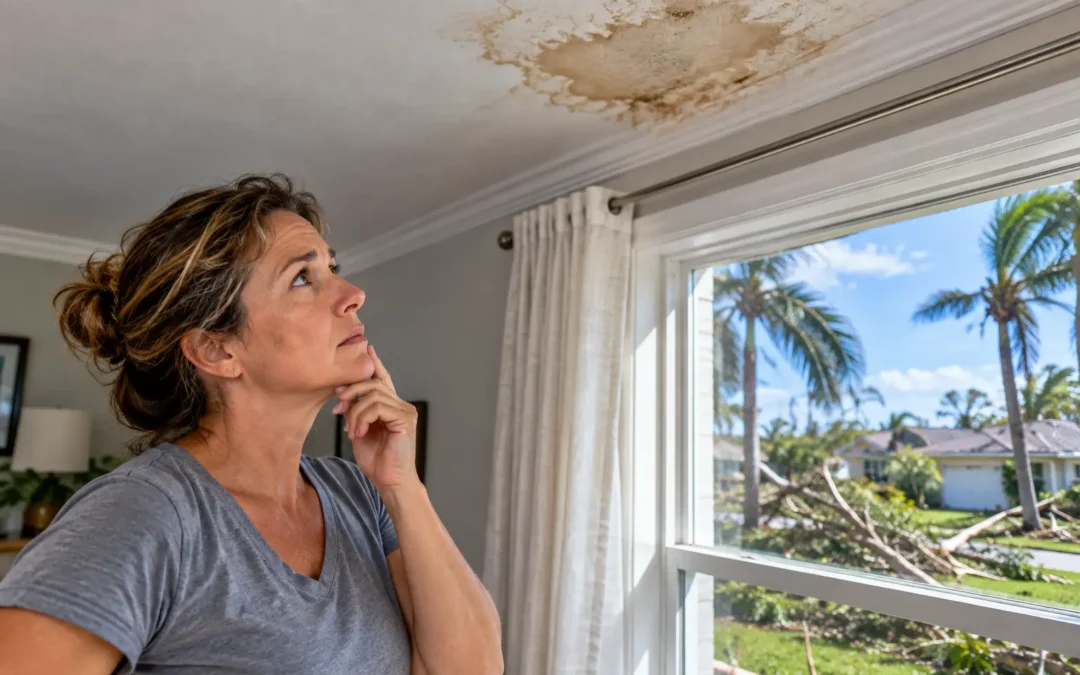
The wind has stopped. The rain has moved on. You walk around the house, pick up a few branches, look toward the roof and feel relieved.
Nothing looks terrible.
And that may be true.
But after a hurricane or severe windstorm, there’s another question worth asking before deciding everything is fine:
What changed?
Storm damage doesn’t always announce itself with a tree through the roof or shingles scattered across the front yard. Sometimes the first clue is much smaller—a ceiling stain that wasn’t there before, a damp smell in a room, a piece of soffit that looks different, water near a window, or something about the roofline that simply doesn’t look the way you remember it.
None of those things automatically proves that your home has significant storm damage or that an insurance policy will cover it. But they can give you a reason to look more carefully at what happened before, during, and after the storm.
Because the most useful question may not be:
“Does my house look damaged?”
It may be:
“What is different about my house today that wasn’t different before the storm?”
Don’t Just Look for Damage — Look for What Changed
After a major storm, most homeowners naturally look for the obvious things first. Missing shingles, broken windows, fallen trees, damaged fencing, or water pouring through a ceiling are hard to miss. But if none of those things happened, it’s easy to walk back inside and assume the house came through untouched.
A better way to look at the property may be to stop asking whether something looks bad and start asking whether something looks different.
Maybe a ceiling has a faint stain that wasn’t there before. A window that never leaked now has moisture around it. A section of soffit looks loose. Paint begins bubbling several days later. You notice granules or roofing material on the ground. Or perhaps a room develops a damp or musty smell even though you can’t see an obvious source.
None of those observations, by themselves, tell you exactly what caused the condition. And they certainly don’t mean every unusual mark after a storm is hurricane damage.
But they give you something much more useful than a guess:
A reason to compare the house you have today with the house you had before the storm.
That’s where photographs can become surprisingly important. Look through pictures on your phone from birthdays, holidays, family gatherings, real-estate listings, home projects, or even ordinary snapshots. A photograph taken months ago for an entirely different reason may show a ceiling, wall, window, roofline, fence, or exterior area in the background.
Now compare it with what you’re seeing today.
What’s different?
You aren’t trying to become a roofing expert or determine insurance coverage from a photograph. You’re beginning to build something simpler—and potentially very valuable:
a before-and-after story of your home.
Where Should You Look After a Storm?
You don’t need to climb onto the roof to begin looking for changes after a storm. In fact, unless you’re qualified and can do so safely, stay off the roof. A useful first look can happen from the ground and from safe areas inside your home.
Start outside. From a safe location, look at the roofline, gutters, soffits, fascia, siding, windows, screens, fences, and exterior doors. Look around the yard for pieces of roofing material or other debris that may have come from the house. You’re not trying to diagnose damage from the ground. You’re simply looking for something that appears different from before the storm.
Then walk through the inside of the home. Look at ceilings and walls, particularly around windows, exterior doors, and areas beneath the roof. Check rooms you don’t use every day. If you can safely view an accessible attic area without walking across joists or disturbing insulation, look for obvious signs of water intrusion—but don’t put yourself at risk trying to investigate a difficult area.
And don’t assume the inspection ends the morning after the storm.
Some changes may become noticeable later. A faint ceiling stain may darken. Paint may begin to bubble. Flooring may change. A damp or musty odor may develop. Something that seemed insignificant on Monday may look very different by Friday.
If you notice something, take a photograph. Then take another photograph from farther back so you can tell where in the house the condition is located. If it changes over the following days, photograph it again.
That creates something more useful than a collection of close-up damage pictures.
It creates a timeline.
And here’s a question worth asking as you walk through the house:
“If I had to show someone exactly what changed after this storm, could I?”
If the answer is no, that’s a good place to start documenting.
The Damage You Notice Three Days Later Still Deserves a Date
Not everything a homeowner notices after a storm appears immediately. The morning after the weather clears, a ceiling may look normal. A few days later, a faint stain appears. After another heavy rain, it becomes easier to see. Somewhere else, flooring begins to change or a musty odor develops in a room that never smelled that way before.
When something appears later, don’t rely on memory alone.
Take a photograph and record the date you first noticed it. If the condition changes, photograph it again. Keep those pictures together with any photographs or videos you took immediately after the storm, along with receipts, repair records, inspection information, and correspondence related to the property.
This isn’t about trying to decide for yourself exactly what caused every condition. A stain that appears after a hurricane isn’t automatically proof that the hurricane caused it. That’s a separate question.
What you’re doing is preserving the sequence of events.
Think about the difference between saying, “There’s a stain on my ceiling,” and being able to say, “Here’s what the ceiling looked like before the storm. Here’s what it looked like the morning afterward. Here’s the photograph I took when I first noticed the stain three days later. And here’s how it changed after that.”
Now you’re not relying entirely on memory.
You have a timeline.
And that timeline can lead to a question many homeowners don’t think to ask:
“If something showed up after the original inspection, does anyone involved in my claim know about it?”
Florida’s Department of Financial Services also recommends documenting storm damage and repairs with photographs or video and keeping receipts.
That doesn’t mean the condition was necessarily missed during the first inspection. It may not have been visible then. Additional information can become available as conditions change or repairs begin.
But if the house is telling you something new, your claim paperwork can’t account for information nobody has documented.
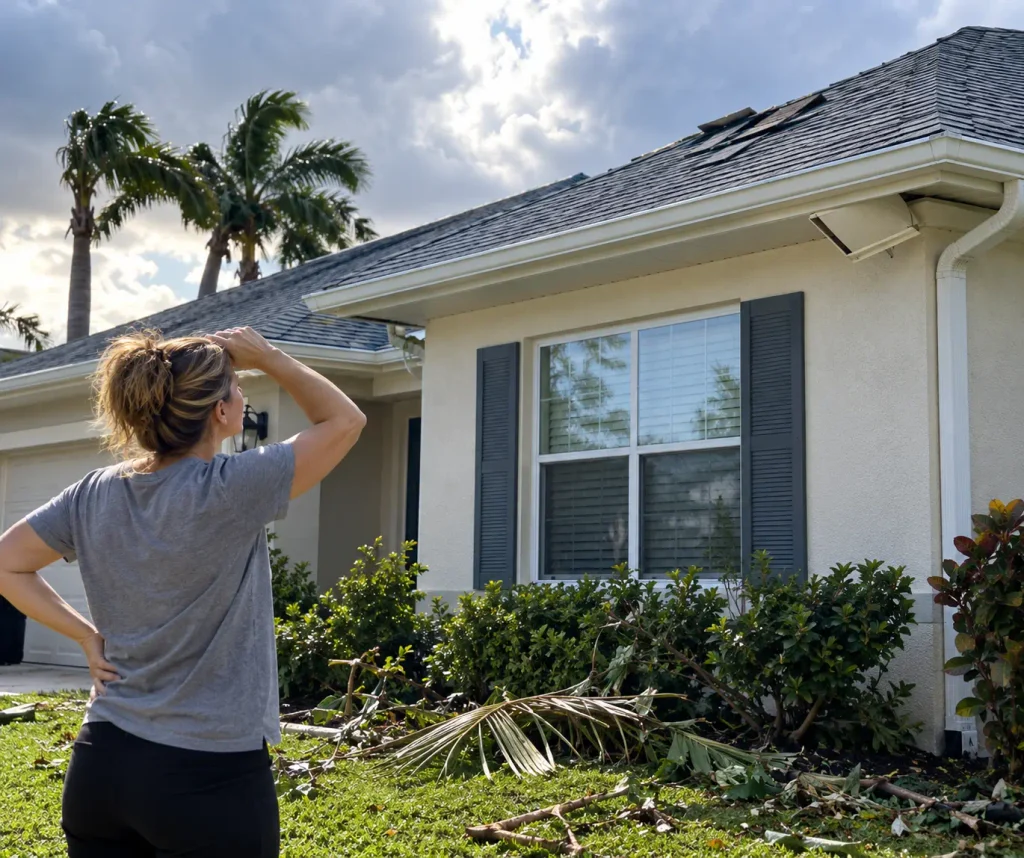
The biggest clue after a storm may not be what looks damaged. It may be what looks different.
The First Inspection Is a Snapshot, Not a Time Machine
When someone inspects a home after a storm, they’re looking at the property as it exists at that moment. They can document what is visible, examine areas that are accessible, take measurements, photographs, and notes, and evaluate the conditions they find.
But an inspection can’t show what hasn’t become visible yet.
A small stain may appear later. Materials may begin showing signs of moisture after the inspection. Repairs may expose conditions that couldn’t previously be seen. Even the homeowner may remember something afterward—a photograph, a strange sound during the storm, or an area where water appeared and then seemed to disappear.
That doesn’t automatically mean the original inspection was inadequate. It means a home can reveal information over time.
This is why the homeowner’s role doesn’t necessarily end when the inspector drives away. If something changes afterward, document it. If repairs uncover something unexpected, photograph it. If a new condition appears in an area that seemed fine during the first inspection, make a note of when you first noticed it.
Then ask a simple question:
“Is this new information reflected anywhere in my claim?”
That’s a very different question from assuming someone did something wrong.
It’s simply asking whether the claim has kept up with the story the house is telling.
Storm Damage — Claim Compass Checkpoint 🧭
By now, you’ve probably noticed that understanding storm damage isn’t only about finding something broken. It’s about understanding what changed, when it changed, and whether those changes became part of the story of your claim.
So take a moment and think about your own home.
When you walked around after the storm, did you really know what you were looking for—or were you mostly relieved that nothing looked catastrophic?
Have you gone back through your phone and looked for photographs showing what your home looked like before the storm?
Did anything appear days later that wasn’t obvious during the first inspection?
If there was an insurance inspection, do you know which areas were actually examined and documented?
And here’s a harder question:
If something was overlooked, appeared later, or simply wasn’t visible at the time—how would you know whether it’s accounted for in your claim today?
You don’t need to assume that something is missing. Maybe everything was identified, documented, and addressed exactly as it should have been.
But if you’re reading these questions and finding yourself saying “I’m not sure” more often than you expected, that’s useful information too.
Because sometimes the first sign that a homeowner needs another set of eyes isn’t discovering a dramatic problem.
It’s realizing:
“I don’t actually know whether anyone looked at the whole picture.”
What If Your Answer Is “I’m Not Sure”?
That’s actually a reasonable answer.
Most homeowners don’t spend their lives studying roofs, water intrusion, construction estimates, or insurance claim documents. You may know your home extremely well and still not know whether every storm-related condition was identified, whether something that appeared later matters, or whether the paperwork in front of you reflects everything that happened.
You also don’t need to convince yourself that something is wrong just because you have questions.
Sometimes a second look confirms that things make sense. Sometimes it uncovers a question worth asking. And sometimes simply having someone walk through the sequence with you—what happened during the storm, what changed afterward, what was inspected, and what was documented—can make the situation much easier to understand.
So if you’re sitting there thinking:
“I noticed something, but I don’t know if it matters.”
“I’m not sure they looked at that area.”
“Something changed after the inspection.”
or simply:
“I don’t really understand what my claim includes.”
Those aren’t conclusions.
They’re good questions.
And you don’t have to know the answers before asking someone for help.
Still Wondering What the Storm Did to Your Home?
If you’ve noticed something different since the storm—or you’re simply not sure whether everything was identified and documented—you don’t have to diagnose the problem before reaching out.
Tell us what happened.
Maybe you’ve found a new stain. Maybe something doesn’t look right around the roof or exterior. Maybe an inspection has already taken place and something appeared afterward. Or maybe you’ve looked at your claim paperwork and realized you’re not completely sure what was included.
We can start there.
A conversation doesn’t mean there’s something wrong with your claim, and it doesn’t mean you need to make a decision about anything today. It simply gives you a chance to explain what happened, what you’re seeing now, and what questions are still bothering you.
Sometimes everything makes sense once the pieces are put together.
Sometimes one piece deserves another look.
And if you’ve reached the point where you’re thinking—
“I’d just like someone who understands this to look at my situation.”
—that’s a perfectly reasonable place to start.
There’s no charge to start the conversation.