

You notice a dark spot near the bottom of a wall. Maybe there’s a musty smell in the room that wasn’t there before. At first, the problem seems obvious: you have mold, and you need to get rid of it.
But there’s a question that may matter even more than “How do I remove the mold?”
Why is it growing there in the first place?
Mold needs moisture. So when mold appears inside a home, what you’re seeing may be evidence of another problem that deserves attention: a leak, water intrusion, lingering moisture, condensation, or another source that allowed the area to remain damp. The mold may be what finally got your attention. The moisture story may have started earlier.
And for a homeowner dealing with a property insurance claim, that distinction can matter.
Because cleaning what you can see and understanding what happened to the home are not necessarily the same thing.
You notice a dark spot near the bottom of a wall. Maybe there’s a musty smell in the room that wasn’t there before. At first, the problem seems obvious: you have mold, and you need to get rid of it.
But there’s a question that may matter even more than “How do I remove the mold?”
Why is it growing there in the first place?
Mold needs moisture. So when mold appears inside a home, what you’re seeing may be evidence of another problem that deserves attention: a leak, water intrusion, lingering moisture, condensation, or another source that allowed the area to remain damp. The mold may be what finally got your attention. The moisture story may have started earlier.
And for a homeowner dealing with a property insurance claim, that distinction can matter.
Because cleaning what you can see and understanding what happened to the home are not necessarily the same thing.
The Mold May Be New to You — But the Moisture May Not Be
One of the confusing things about mold is that the day you discover it may not be the day the problem began.
A homeowner might move a piece of furniture and notice discoloration along a baseboard. A musty odor may suddenly become noticeable in a bedroom or closet. Paint may begin bubbling near a wall that looked perfectly normal a few weeks earlier. In other cases, mold becomes visible after a plumbing leak, roof leak, appliance failure, or other water event that seemed to have already been handled.
That’s where the timeline becomes important.
According to the EPA, controlling moisture is the key to controlling mold. If mold is growing inside a home, simply focusing on the visible growth may leave an important question unanswered: where did the moisture come from, and is that moisture problem actually resolved?
Consider a wall that looks dry from the outside. What happened inside the wall cavity? What about the insulation, drywall backing, baseboard, flooring, or adjoining room? Water doesn’t necessarily stay neatly inside the area where it was first noticed.
This doesn’t mean every mold discovery is evidence of extensive hidden damage. Sometimes a small problem really is a small problem. But until the moisture source and affected area are understood, the homeowner may not know which situation they’re dealing with.
And that changes the first question worth asking.
Instead of starting with “How much mold can I see?”, it may be more useful to ask:
“What happened here that allowed mold to grow?”
That question begins an investigation instead of ending one.
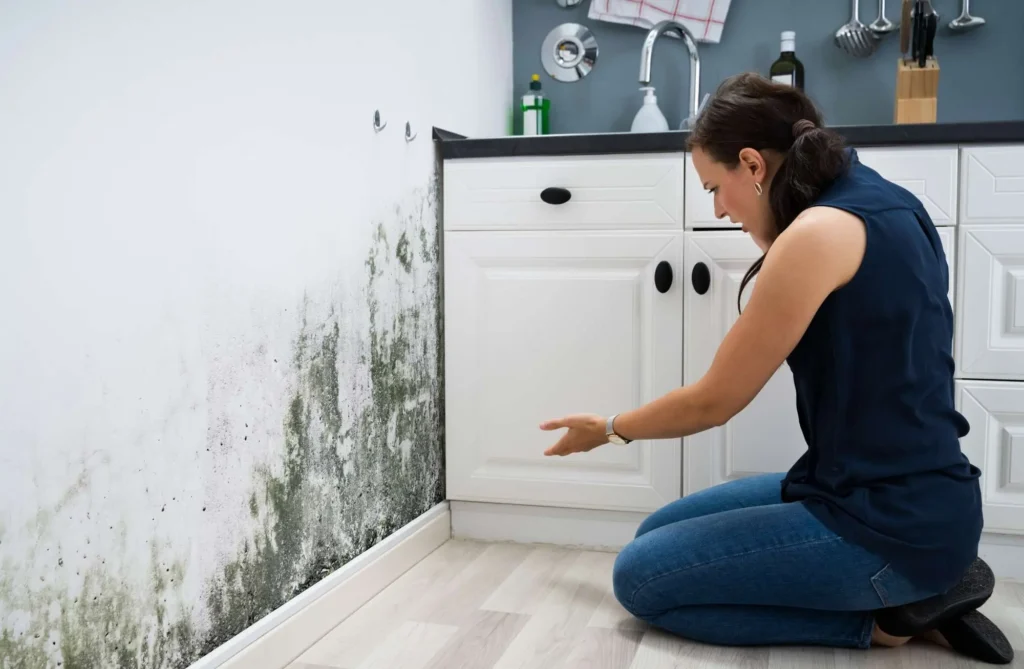
What You Can See May Not Tell You Where the Water Went
Water has an inconvenient habit of taking its own path through a home. It can move along building materials, enter wall cavities, affect flooring, or reach adjoining areas before there is an obvious sign on the finished surface. By the time discoloration or mold gets a homeowner’s attention, the most visible spot may be only one piece of the story.
Imagine discovering mold along the bottom of a kitchen wall. The natural reaction is to focus on that spot. But if moisture reached that area from a leaking pipe, appliance, roof opening, window, or another source, the more useful investigation may begin several feet—or even another room—away.
This is why photographs taken over time can become surprisingly valuable. A ceiling stain that appeared weeks earlier, a warped baseboard, flooring that began lifting, or a cabinet that developed an unusual odor may seem unrelated when each is viewed by itself. Put those observations together, however, and they may help tell the story of how moisture moved through the property.
For a homeowner with an insurance claim, that story can matter. The question isn’t simply whether mold exists. It is whether the water event, the areas it affected, and the resulting damage were properly identified and documented.
And here’s where homeowners can do something useful without becoming mold experts, contractors, or insurance adjusters: go back through the photographs and videos on your phone.
What changed first?
Sometimes your phone remembers something you didn’t.
Your Phone May Already Contain Part of the Story
Most homeowners don’t photograph their house because they expect to build an insurance claim. They take pictures because something looks strange, because they want to text a spouse or contractor, or because they’re trying to remember what happened.
Those ordinary photographs can become surprisingly useful later.
Scroll backward through your camera roll and look at the affected area before the mold appeared. You may find a photograph showing a faint stain that later became darker, flooring that looked slightly different, a baseboard beginning to swell, or belongings that were moved because an area felt damp. Even photographs taken for completely unrelated reasons may show the room in the background.
Don’t worry about diagnosing what caused the problem from a photograph. That’s not the goal. You’re simply trying to establish a timeline: What did this area look like before, when did something begin to change, and what happened afterward?
Then create a simple folder on your phone and save the relevant pictures together. If you take new photographs, include wider shots showing where the affected area is located as well as closer photographs showing the condition itself. Keep invoices, reports, emails, and other documents related to the water event too.
What you’re creating isn’t a dramatic collection of mold pictures.
You’re creating a history of what happened to your home.
And once you have that history in front of you, another question becomes much easier to ask:
Does the claim paperwork tell the same story?
When the Mold Appears, Go Back to the Original Water Damage
If the mold appeared after a known water event, pull out the documents from that event and look at them with fresh eyes. Start with the original photographs, inspection information, drying or restoration records, repair estimates, and any correspondence related to the claim.
You’re looking for something fairly simple: Do those documents account for the areas where you’re now seeing a problem?
For example, if mold later appears along the bottom of a wall, was that wall identified as affected when the water damage was first inspected? If flooring or baseboards now show changes, were those materials documented? If the moisture appears to have traveled into an adjoining room, does that room appear anywhere in the paperwork?
There can be perfectly reasonable reasons why later conditions weren’t visible during an earlier inspection. Materials can conceal moisture, conditions can change, and additional information can become available as repairs progress. Finding mold later does not automatically mean somebody missed something or that an insurance company is responsible for every condition discovered afterward.
But it does give the homeowner a reason to compare what is happening in the house now with what was documented then.
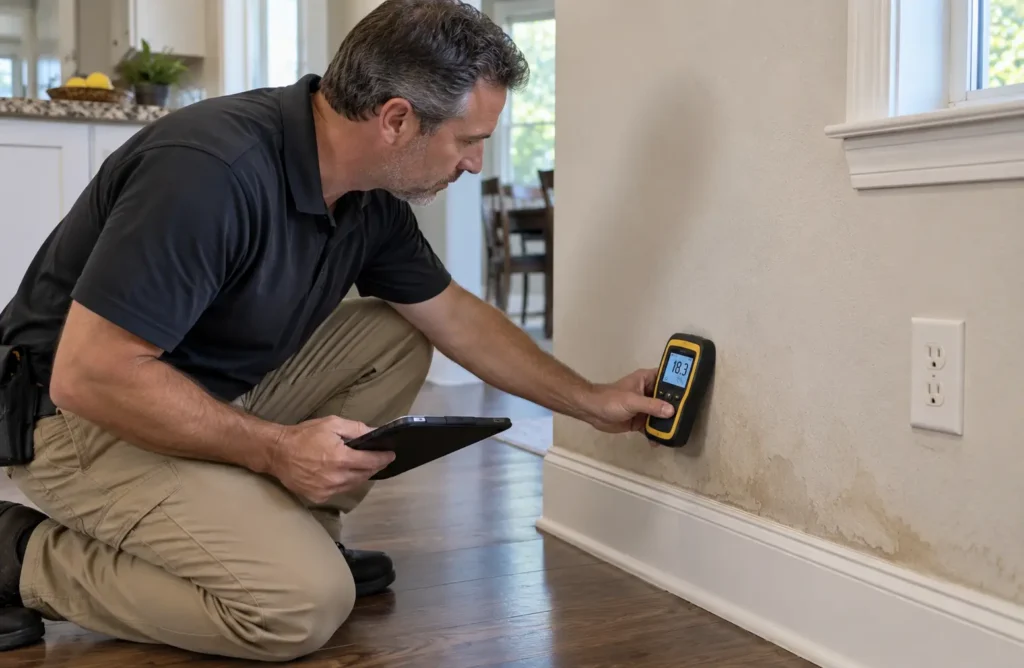
That’s where a moisture investigation can become important. A qualified professional may use moisture measurements and other appropriate methods to help evaluate where moisture is present and what materials may be affected. The goal isn’t simply to point at a dark spot and say, “That’s mold.”
The more useful question is:
“What allowed this condition to develop here—and does the documentation I already have account for that part of the story?”
Mold and an Insurance Claim Are Not Automatically the Same Thing
This is where mold claims can become confusing. Finding mold in a home does not, by itself, answer the insurance question. What happened before the mold appeared can be extremely important.
Was there a sudden plumbing leak? Water from a damaged roof? An appliance failure? Long-term moisture? Condensation? An older problem that was never completely resolved? The source, timing, policy language, and circumstances of the loss can all matter when an insurer evaluates a claim.
That’s why homeowners should be careful about jumping to either conclusion: “I found mold, so insurance must cover it,” or “It’s mold, so insurance won’t cover it.” Neither assumption tells you what your particular policy says or how the circumstances of your loss may be evaluated.
Instead, go back to the beginning. What happened first? When was the water discovered? What was done to stop it? Which areas were documented? What was removed or dried? What did the original inspection identify? And what appeared later?
Think of it less as trying to prove a mold claim and more as building a timeline of what happened to the property. The clearer that timeline becomes, the easier it is to compare the condition of the home with the documents in the claim file.
And sometimes that comparison produces a very important question:
“Is the problem I’m looking at today connected to damage that was already part of this loss?”
You don’t need to guess at the answer.
But you do need to know enough to ask the question.
Cleaning Up the Mold Doesn’t Explain Why It Was There
Once mold is discovered, most homeowners want it gone. That’s understandable. Moisture problems should be addressed, and appropriate cleanup or professional remediation may be necessary depending on the conditions involved.
But there is an important difference between correcting a problem and documenting what caused it.
Imagine a homeowner discovers mold along a wall, photographs it quickly, and then has the affected material removed. The room may look better afterward, but several questions can become harder to answer: How far did the moisture extend? Which materials were affected? Where did the water originate? Were adjoining areas involved? What did the condition look like before materials were removed?
That doesn’t mean a homeowner should delay necessary action just to preserve evidence. Preventing additional damage and addressing unsafe conditions are important. The better approach is to think about documentation and mitigation together whenever reasonably possible: take photographs and video, keep relevant invoices and reports, note what was removed, and preserve useful information about the condition before it disappears.
There’s another reason this matters. A mold remediation company may understandably be focused on safely addressing the mold condition. A plumber may be focused on finding or repairing a leak. A restoration company may be focused on drying affected materials. A contractor may be thinking about reconstruction.
Each professional may be looking at a different piece of the same puzzle.
The homeowner is often the one person who has lived through the entire sequence.
So before the visible evidence disappears, make sure the story doesn’t disappear with it.
Because weeks later, when you’re looking at an estimate, payment, report, or claim decision, the question may no longer be:
“Was there mold on this wall?”
The much harder question may be:
“Can I still show what happened here?”
Mold & Moisture — Claim Compass Checkpoint 🧭
Before you move on, take a moment and think about the story your home is telling you.
If you discovered mold after a leak or other water event, can you identify where the moisture came from, where it traveled, and which areas were actually documented? Do your photographs, restoration records, inspection information, and insurance paperwork seem to describe the same affected areas you’re looking at today?
If materials have already been removed or cleaned, do you still have photographs or records showing what was there beforehand? And if mold appeared somewhere that wasn’t part of the original damage assessment, has anyone explained why it appeared there?
You don’t need to assume that something was missed. You don’t need to assume that every mold condition is part of an insurance claim either.
But there is one question worth answering:
Do I understand the connection between the water that entered my home, the damage that was documented, and the condition I’m seeing now?
If the answer is “I’m not sure,” you’ve found the part of the story that deserves another look.
When the Story Still Doesn’t Add Up
Finding mold in your home can send you down several different paths at once. You may be thinking about cleanup, where the moisture came from, what needs to be repaired, and whether any of it connects to an insurance claim you already have—or perhaps one you haven’t filed yet.
You don’t have to figure out every part of that puzzle by yourself.
If you’ve had water damage, discovered mold afterward, or simply aren’t sure whether the damage to your home was fully identified and documented, Claim Compass Guide can help you take a closer look at what you’re dealing with.
The goal isn’t to convince you that something is wrong with your claim. It’s to help you understand what happened to your property, what has been documented, and what questions may still need answers.
Sometimes everything lines up.
Sometimes one piece doesn’t.
And sometimes that one piece is the reason a homeowner finally says:
“I think I need someone to look at this.”
If that’s where you are, reach out and tell us what happened. There’s no charge to start the conversation, and we’ll help you determine what the next step may be.
Your home has already given you a clue. Now let’s make sure you understand the story behind it.
That’s what a compass is for. 🧭
Not Sure What You’re Looking At?
If you’ve discovered mold or moisture damage and something about the situation doesn’t make sense, tell us what happened. You don’t need to know the insurance terminology, and you don’t need to have all the answers before reaching out.
We can start with the basics: what happened, what you’re seeing now, whether an insurance claim is involved, and what documentation you already have.
Sometimes a short conversation is enough to point you in the right direction.